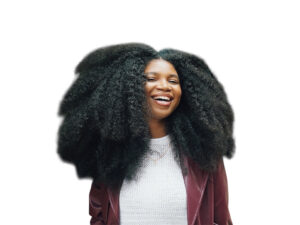
For much of my life, my hair was treated as something that needed to be managed, altered, or made more “acceptable.” Growing up as a Black girl in the United States, I learned early that my natural texture, coils, volume, and shrinkage were often misunderstood or stigmatized. The message, spoken and unspoken, was clear: my hair was too much. Too big. Too different. And because my hair was so deeply tied to my identity as a youth, those messages impacted how I saw myself.
Like many, I spent years navigating expectations that suggested professionalism, beauty, and confidence were dependent on how closely I could conform to Eurocentric standards. I internalized the idea that my natural hair was something that I would always need to hide, pull back, or change to fit in. That belief followed me into young adulthood. Influencing how I showed up in rooms, in photos, and even in how I spoke about myself.
My turning point came when I realized that I was tired of being burned by the flat iron and that all this altering of my hair was not bringing me closer to confidence or happiness. It was actually distancing me from being myself. Choosing to embrace my natural hair was not a single decision, but a process of unlearning and shifting my mindset. I had to unlearn the feeling of embarrassment. I had to unlearn the belief that my hair needed permission to exist as it is. Transitioning from relaxers and flat irons to braids and puffy ponytails was emotional and, at times, uncomfortable. There were many moments of doubt and fear of judgment, but there was also a growing sense of peace that made it all worth it.
Caring for my natural hair became an act of self-respect. I learned that healthy hair care is not about perfection. It’s about patience, consistency, and taking care of your body. Through trial and error, I gained confidence not only in styling my hair but also that my hair was good enough to go into every room with me.
Today, I share my hair story because representation matters. When young girls see women who look like them wearing their natural hair with pride, it challenges the narrative that they must change to be worthy. I want them to know they are not alone in questioning, transitioning, or learning. There is no “right” timeline to start or see results, and no single way to wear your hair. Your hair does not need to be tamed to be accepted.
Embracing my natural hair has given me confidence, alignment, and community. It has allowed me to show up fully, authentically, and unapologetically in my life and work. I hope that by sharing my story, I can contribute to a global movement that reminds people everywhere that their hair is not a limitation. It is history. It is culture. It is power.